 Gateway to Mars
September 21, 2026
The FCC just put SpaceX's 100,000-satellite application on public notice: the constellation Starship exists to launch
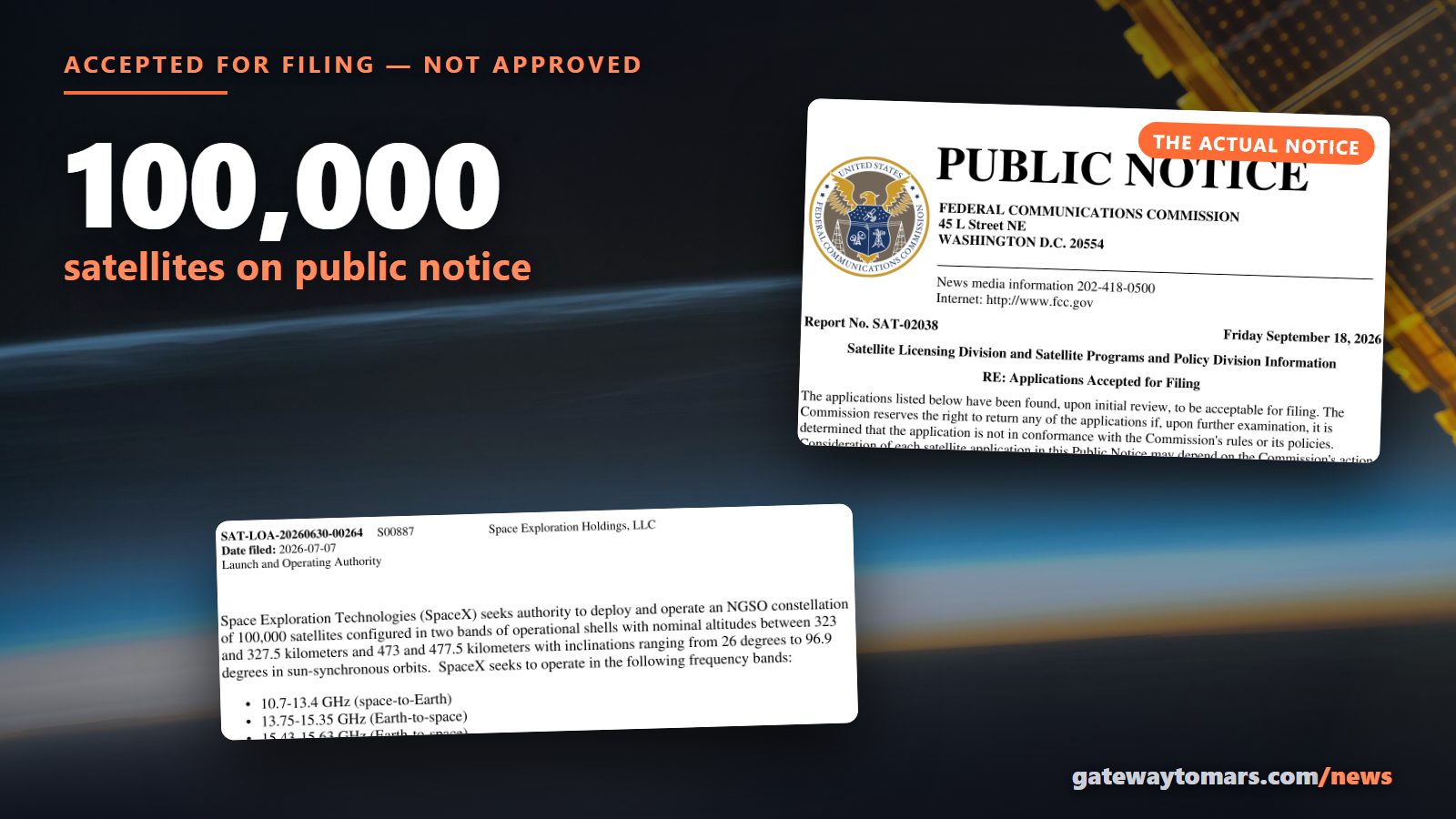
Quietly, on Friday afternoon, the biggest number in SpaceX's regulatory pipeline moved a step forward. FCC Public Notice SAT-02038 (September 18), from the Satellite Licensing Division, lists SpaceX's application SAT-LOA-20260630-00264, filed July 7, as accepted for filing: authority to deploy and operate an NGSO constellation of 100,000 satellites in two bands of operational shells at 323–327.5 km and 473–477.5 km, inclinations from 26° to 96.9°, with requested frequencies running from 10.7 GHz all the way up through 275 GHz. Read the words carefully, because the FCC chooses them carefully: accepted for filing means the paperwork is complete enough to go on public notice. It is explicitly not approval. The same notice says the Commission "reserves the right to return any of the applications," and it opens the window for petitions and oppositions under §25.154. SpaceX also asks for waivers of seven Commission rules to make the plan fit.
The Starbase angle is arithmetic. Flight 14, still targeting Monday, September 28, carries 26 Starlink V3 satellites, per SpaceX's own mission page. At that rate, 100,000 satellites is roughly four thousand Starship flights; even if later ships carry several times as many, this filing is a decades-long launch manifest for the pad up the road, and the operational shells in the application sit just above the ~275 km insertion orbit we broke down September 17. Every satellite in this application that ever flies is planned to leave Earth from a launch mount you can see from Highway 4 (or its future Florida sibling). If you want one number that explains why Starbase annexes land, builds Gigabays, and files for more launches, it's this one.
What we're deliberately not repeating: trade coverage attributes per-satellite specs (about 1 terabit per second of downlink each, optical space lasers) to SpaceX's underlying application. Those numbers aren't in Friday's notice, so we cite them only as consistent with what SpaceX's Flight 14 page already told us: 26 V3 satellites adding ~26 Tbps of capacity. No approval timeline exists yet, and the petition window is now open. Expect the usual objections from competitors and astronomers before this one is decided.
Sources: FCC Public Notice, Report No. SAT-02038, Sept. 18, 2026 (PDF — read in full) · FCC — "Accepted for Filing" document page · SpaceX — Starship Flight 14 (26 Starlink V3, ~26 Tbps) · SatNews (July 8) — the original filing
Know before the next launch: get free Launch Alerts by email, or follow us on X, Facebook and WhatsApp.