 Gateway to Mars
Starship November 27, 2026 · Mexico City · Airspace
Mexico wants airspace talks with the U.S. over Starbase launches, and Sheinbaum raises moving the launch site if needed
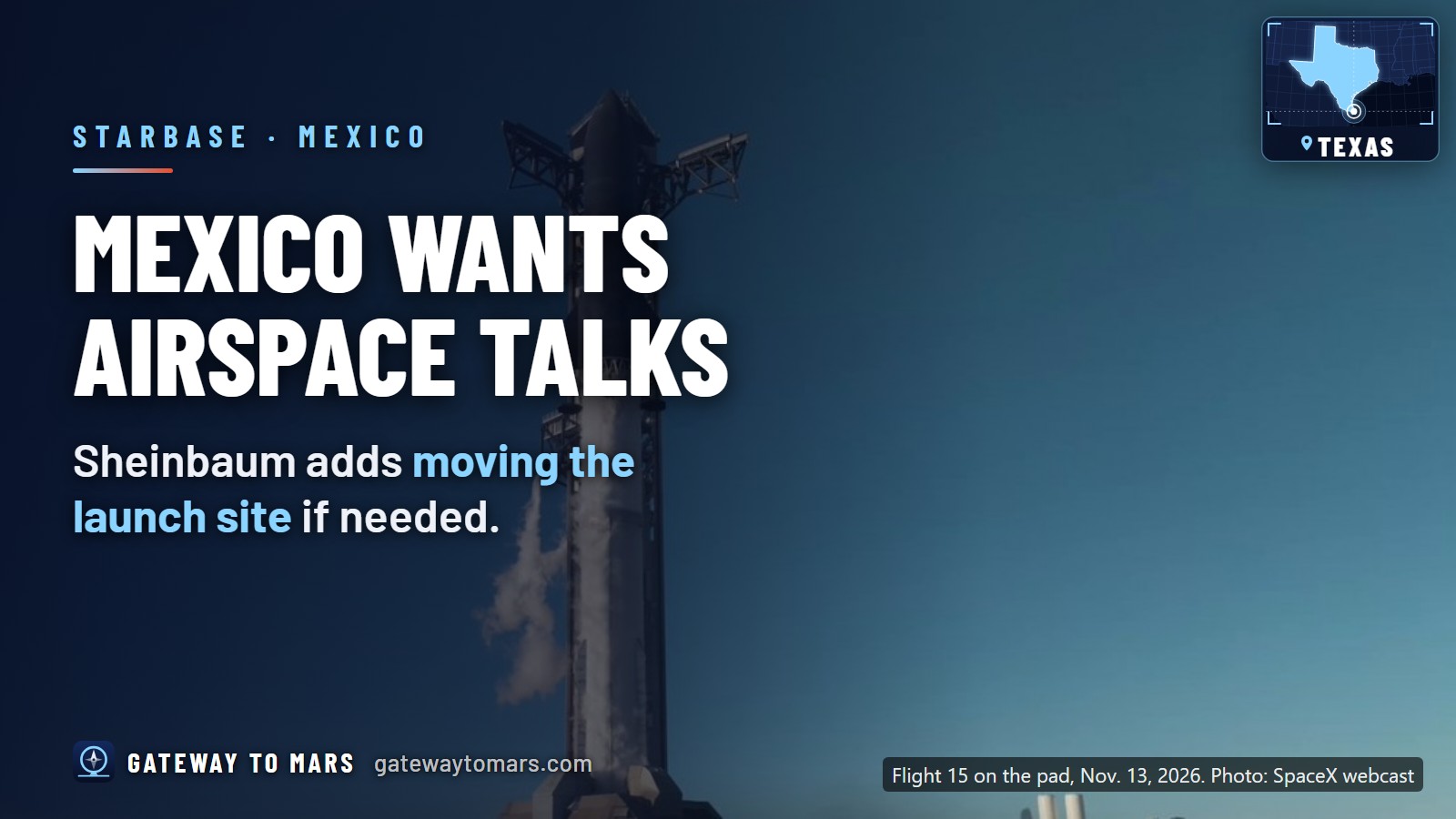
Mexico is seeking a meeting between U.S. and Mexican airspace authorities to set permission for Starbase rocket flights to use Mexican airspace, and how often, President Claudia Sheinbaum said at her morning press conference Thursday, Nov. 26, 2026. "And in any case, if it were necessary, the relocation of the launch zone," she added, according to the government's transcript (Spanish; our translation).
- Why: when the rockets fly, Sheinbaum said, they use part of Mexican airspace, and that requires authorization from Mexico's aviation agency.
- The number she raised: "if there come to be, as they think, 400 flights a year," she asked, what would that mean for Mexican airspace? The FAA is reviewing up to 456 Starship launches a year at Starbase (our Nov. 23, 2026 story).
- Who Mexico is talking to: Mexico met with the U.S. Embassy, because "the relationship is with the government of the United States, not with the company SpaceX," Sheinbaum said.
- The debris: separately, she said Mexico's environment agency, PROFEPA, is investigating debris that reached Mexican waters and could sanction the company. PROFEPA said Nov. 17, 2026 that materials that may be from the Flight 15 booster were washing up on Playa Bagdad (live desk).
Not said: a date for the meeting, or any reply from the U.S. government or SpaceX.
Next: FAA comments on the Starbase launch review close Mon. Dec. 7, 2026 (our Nov. 23, 2026 story), and Starbase's City Commission holds its SpaceX tax abatement hearing at 7 p.m. CT Wednesday, Dec. 9, 2026 (our Nov. 22, 2026 story).
Around the world
The FCC announced Wednesday, Nov. 25, 2026, that it approved SpaceX's plan to deploy one million Starmind AI data-center satellites, Space.com reports. SpaceX aims to launch the first of them on Starship in the third quarter of 2027, Space.com says.
ESA says this year's ozone hole over Antarctica ranks as one of the largest in 48 years, reaching 27.3 million square kilometers by Sept. 20, 2026. ESA says the ozone layer's long-term recovery remains on track.
ESA says it will unveil Gaia Data Release 4, the mission's first principal data release, on Wednesday, Dec. 2, 2026. ESA says the release draws on half the observations from Gaia's 11-year lifetime.
Sources: Presidency of Mexico, press conference transcript, Nov. 26, 2026 (Spanish) · Space.com, Nov. 25, 2026 · ESA, ozone hole · ESA, Gaia DR4
Know before the next launch: get free Launch Alerts by email, or follow us on X and Facebook.