 Gateway to Mars
Local economy November 4, 2026 · Cameron County · Permits
Rio Grande LNG's sixth train would add about 1.28 million tons of CO2 a year, its Texas air application proposes
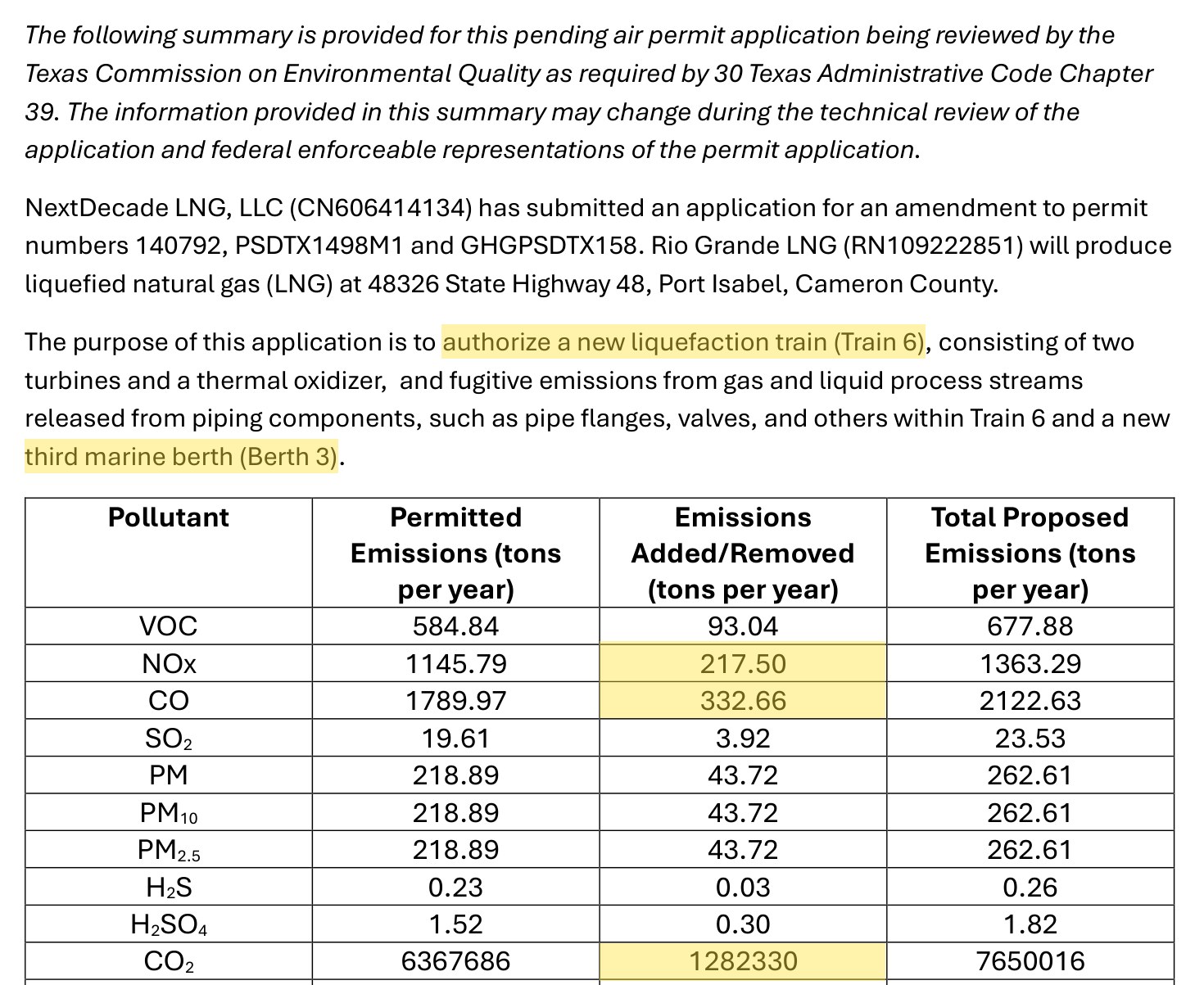
NextDecade has asked Texas to amend the air permits for Rio Grande LNG, its export terminal on State Highway 48 east of Brownsville, to add a new liquefaction train, Train 6, and a third marine berth. The application, received May 22, 2026, proposes adding 1,282,330 tons of carbon dioxide a year, for a proposed permit total of about 7.65 million tons across the site.
That application is pending. TCEQ's permit file showed no preliminary decision on it Wednesday morning, and the summary says its figures "may change during the technical review."
- What Train 6 includes: two turbines and a thermal oxidizer, plus leaks from piping parts such as flanges and valves, and the new berth.
- Proposed additions, tons a year: 332.66 of carbon monoxide, for a total of about 2,123; 217.50 of nitrogen oxides, for about 1,363; and 93.04 of volatile organic compounds, for about 678.
- The starting point: those totals start from the figures in the separate request below, which isn't final.
A separate decision: in a notice dated Oct. 30, 2026, TCEQ's executive director "made a preliminary decision to issue the permit" on a different amendment, requested Jan. 14, 2026. It does not cover Train 6. That application says it updates emissions for "existing equipment without design changes," generally from updated vendor information and data refinements.
- Proposed changes, tons a year: nitrogen oxides up 33.53 to 1,145.79, carbon monoxide up 66.23 to 1,789.97, volatile organic compounds up 103.03 to 584.84, and particulate matter down 38.53 to 218.89. Its greenhouse gas total, in CO2 equivalent, would fall 14,511 tons.
- Not final: the notice says the executive director will respond to comments and "may then issue final approval," because "no timely hearing requests have been received."
- Comments: the notice allows 30 days from the date it runs in a newspaper. We haven't found that date, so we can't give a deadline yet. Comments go through TCEQ's comment page or by mail to its chief clerk, and TCEQ will hold a public meeting if it finds significant public interest or a local legislator asks.
- Where to read it: the notice says the application and draft permit will be at the Brownsville Public Library Main Branch, 2600 Central Blvd., from the first day of publication. We haven't read the draft permit.
Why it matters here: five trains are already under construction at the site. Our Rio Grande LNG story. NextDecade says it filed its Train 6 application with the Federal Energy Regulatory Commission on May 26, 2026.
Next: we'll post the newspaper date and comment deadline when we have them, and report any decision on either application.
Around the world
NASA's Neil Gehrels Swift Observatory is expected to re-enter Earth's atmosphere Wednesday, Nov. 4, 2026, almost 22 years after launch. As of Monday, Nov. 2, 2026, the U.S. Space Force predicted re-entry at about 3:30 a.m. ET (2:30 a.m. CT) Wednesday, Nov. 4, 2026, with an uncertainty of 11 hours, NASA said. NASA had not reported a re-entry as of 8:52 a.m. ET (7:52 a.m. CT). NASA expects most of the roughly 3,200-pound spacecraft to burn up, though some components are expected to survive, and puts the risk of harm to anyone on Earth at about 1 in 2,100.
NASA astronaut Anil Menon is scheduled to answer students' questions from the International Space Station at 11 a.m. ET (10 a.m. CT) Wednesday, Nov. 4, 2026, in a National STEM Day call with STEM content creator Mark Rober, on NASA's flagship YouTube channel. The call also marks the launch of a new collaboration between NASA and the ClassCrunchLabs Foundation, which Rober founded, NASA said.
"Hubble, you can't let it have an uncontrolled re-entry," NASA Administrator Jared Isaacman said in an interview that aired Friday, Oct. 30, 2026. "If you're going to spend money to go up there and do something, you might as well boost it, get as much science as you possibly can out of it." NASA's request for company ideas to boost, service or safely bring down the telescope takes responses until 3 p.m. ET (2 p.m. CT) Monday, Nov. 30, 2026.
Sources: TCEQ Permit Search, No. 140792: Notice of Application and Preliminary Decision (issued Oct. 30, 2026, mailed Nov. 3, 2026) and the application files, read Nov. 3, 2026 and Nov. 4, 2026 · NextDecade, Train 6 expansion page
Know before the next launch: get free Launch Alerts by email, or follow us on X and Facebook.